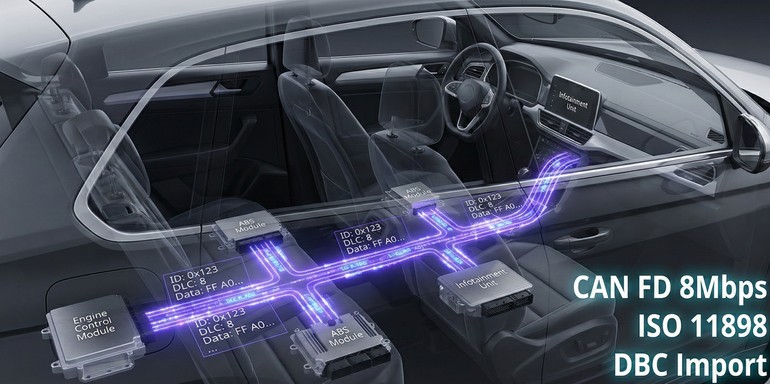
The Communication Stack provides complete solutions for in-vehicle network communication, covering both CAN/CAN FD and LIN protocols. These stacks enable reliable, high-performance communication across embedded automotive systems, from high-speed backbone networks to cost-effective sub-networks.
The implementation is validated across major automotive MCU platforms and integrates seamlessly with LeanCfg for DBC/LDF import and visual configuration.
Power next-generation vehicle networks with robust communication stacks built for performance, scalability, and reliability.
CAN Stack provides a complete communication solution for CAN and CAN FD networks. The stack covers all layers from the CAN Driver to the COM layer, enabling reliable and high-performance in-vehicle network communication across embedded automotive systems.
Supporting both Classic CAN (up to 1 Mbit/s) and CAN FD (up to 8 Mbit/s with 64-byte payloads), the stack integrates seamlessly with LeanCfg for DBC import and visual configuration.
CANIF (CAN Interface): Abstraction layer providing unified access to multiple CAN drivers. Handles PDU routing, Tx confirmation and Rx indication callbacks, controller mode management, and channel mapping.
CANTP (CAN Transport Protocol): ISO 15765-2 compliant segmentation and reassembly for diagnostic and large data transfer. Supports multiple parallel connections with configurable timing parameters such as STmin, Block Size, N_As, N_Bs, and N_Cs.
J1939 Transport Protocol (J1939TP): Implements SAE J1939-21 transport protocol for multi-packet message transfer in heavy-duty vehicle networks, supporting BAM and RTS/CTS mechanisms for reliable large data exchange.
CAN Transceiver: Low-level interface for CAN physical layer control, enabling transceiver mode management, wake-up handling, and bus state monitoring to support power management and network robustness.
COM & PDUR: Signal-based communication layer supporting update bits, signal groups, and deadline monitoring. The PDU Router enables flexible routing between communication modules and higher-layer services.
The LIN Communication Stack provides the core modules required for reliable LIN communication in embedded systems. Designed for both Master and Slave nodes, it supports low-cost sub-networks used in body electronics, lighting systems, seat control, HVAC panels, and compact sensor or actuator clusters.
The stack includes the LIN Driver for frame handling and timing control, the LIN Transceiver Driver for physical-layer mode management and wakeup behaviour, and the LIN Interface (LINIF) for schedule table execution and frame routing. Together, these modules ensure stable and predictable communication across LIN networks.
LIN Transceiver: Manages physical-layer interaction, including operating mode control, bus wakeup detection, and low-power mode support, ensuring stable signaling on the LIN bus.
LINIF (LIN Interface): Manages schedule tables, frame slot processing, and event-triggered or sporadic frames. Provides a unified access point for upper layers, enabling easy configuration and message routing.
LINTP (LIN Transport Protocol): Implements the transport layer for segmented diagnostic communication over LIN, with configurable timing parameters to ensure reliable multi-frame data transfer.